

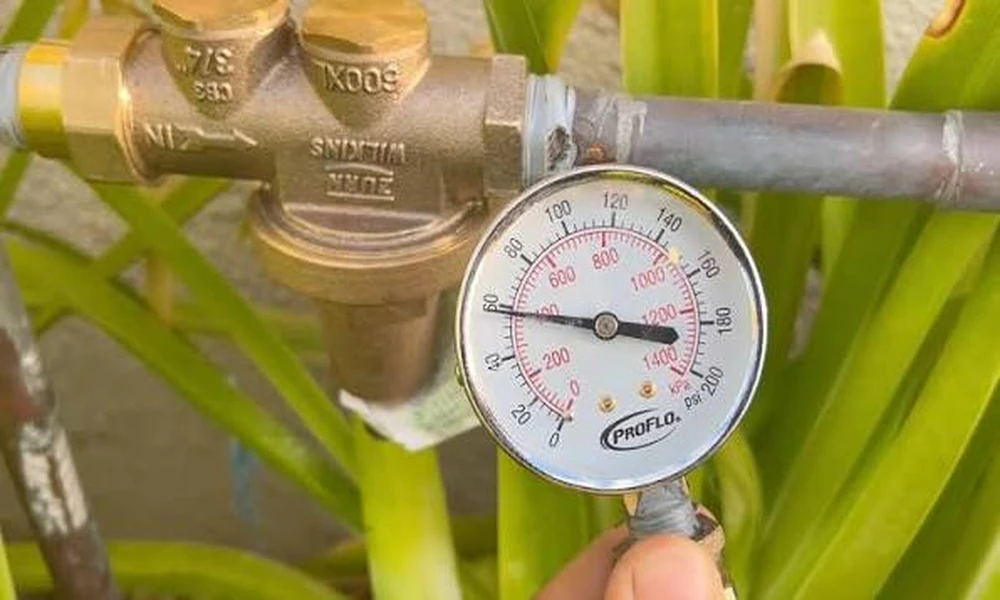
Most people know their shoe size, their blood type and maybe their credit score. Almost nobody knows their water pressure, even though it decides how long every pipe, faucet and appliance in the house will last. Plumbers like the team at Plumb Intended in Georgetown often begin a service call with a small gauge for exactly that reason. The reading is a number, and three of those numbers tell the whole story.
The Floor Is 35
Water utilities have a minimum to hit. In Texas, the state environmental commission expects a distribution system to keep at least 35 psi so that taps and fixtures work reliably. Below that, showers dribble, washing machines fill slowly and sprinklers barely pop up. If your pressure sits near this floor, the cause is usually a clogged aerator, a partly closed valve or a hidden leak rather than a failing city main.
A fast test helps. Turn on every indoor faucet and outdoor spigot. If only one fixture runs weak, clean its aerator or showerhead. If everything runs weak, a leak somewhere in your plumbing may be draining pressure away, and that deserves a closer look.
The Comfortable Zone Is 60 to 80
Most household fixtures are built to live between 60 and 80 psi, and some homeowners prefer to hold things closer to 60 or 70. Plumbing code recommends keeping pressure at 80 or lower inside the house. That range gives a satisfying shower without leaning on every joint in the wall.
The City of Georgetown notes that residential pressure typically runs between 35 and 80 psi, but some areas can reach 100. That is a wide spread, and it is the reason a neighbor’s reading may look nothing like yours.
Past 80, Everything Pays
High pressure rarely announces itself with a bang. It works slowly, stressing washing machine hoses, ice maker lines, toilet fill valves and water heater connections every single time a tap closes. Over months and years, that stress turns into dripping faucets, worn washers and finally a burst pipe on a Saturday morning.
Watch for these hints.
- Faucets that drip even after new washers go in
- Pipes that bang or hum when a valve shuts off
- Toilets that keep running or refill with a rush
- Appliances that fail earlier than their warranties suggest
- Spray from a hose bib that feels more like a pressure washer
Any one of them can have another cause, but several together make high pressure a prime suspect.
Why Pressure Changes From Month to Month
Your reading is not fixed. Elevation matters, since a house at the bottom of a hill sees more pressure than one at the top. Summer irrigation can shift the balance across a neighborhood, and a failing piece of utility equipment can send a surge down the line. That is why the city recommends that customers install their own pressure reducing valve, even though the city operates public valves of its own to protect its mains.
Finding Your Number in Five Minutes
You do not need a plumber to take the first reading. A basic pressure gauge costs little at a hardware store and screws onto an outdoor spigot.
- Close every faucet and make sure no appliance is running
- Attach the gauge to the spigot and open the valve fully
- Read the number and write it down
- Repeat late at night and again on a hot afternoon
Pressure tends to climb when household and neighborhood demand fall, so the late night reading is often the highest. If it ever creeps above 80, a conversation about a pressure reducing valve is overdue. Many properties already have one. In that case the valve may simply need adjusting, cleaning or replacing, because the small parts inside wear out.
What a Pressure Reducing Valve Actually Does
Think of a valve like this as a gatekeeper on the main line. It takes the pressure arriving from the street and drops it to a safe level before it reaches your pipes. That protects fixtures and appliances, steadies the flow and saves water that would otherwise gush out of every tap.
A good installation is not one size fits all. The valve should be chosen to suit the pipe size, the flow rate, the pressure you want and the local municipal supply. After installation, the technician tests the system and adjusts the setting so it guards against both pressure that is too high and pressure that sags too low. Afterward, an occasional inspection and recalibration keeps the valve honest.
There is one detail worth asking about. Once a valve is in place, the house can become a closed system, and heated water in a water heater has nowhere to expand. A thermal expansion tank is the usual answer, so ask whether your setup needs one.
Older Homes Hide Surprises
Some Texas cities point out that buildings constructed before 2002 may have no pressure reducing valve at all, and owners who see high readings are advised to have a licensed plumber add one on the customer side of the water meter. If you live in an older house, never assume the previous owner took care of it. Check, then record the number.
When to Bring in a Professional
If your gauge shows more than 80, if low pressure runs through the whole house or if you hear pipes thumping at night, call a licensed plumber instead of guessing. A technician can pair a pressure reading with an inspection of valves, fixtures and exposed lines, and some use video cameras to look inside drain lines when something deeper is going on.
The Georgetown shop at 361 Logan Ranch Road is family owned, has about twenty years of experience and offers free estimates on pressure reducing valve work. Military customers get 10 percent off, seniors 5 percent. The office runs Monday through Friday from 8 to 5, and you can call (512) 630-9968 to book a visit. Their service area reaches well beyond Georgetown, including Round Rock, Cedar Park, Leander, Hutto and Austin.
Whichever route you choose, get your number this week. Knowing it is the cheapest piece of plumbing insurance a homeowner can own, the City of Georgetown publishes a handy water pressure guide for anyone who wants to read more.
